What AI Is, How It Fails, and Why Your Engineering Discipline Is Your Best Defense.
This guide provides the foundation for disciplined AI-assisted development. It names the AI Plateau, explains the persistent properties of AI interaction, argues that the human is the differentiator, and treats engineering discipline as the passive defense.
What this work does
Gives names to the failure patterns of AI-assisted work.
Most practitioners using AI assistants day to day have lived through the same
small set of failures. The work looked almost right. The same mistake kept coming
back. A run of good output quietly relaxed the review discipline, and something
bad shipped. The failures are real, they are recurring, and — until now — most of
them have not had names.
Human-Assisted AI is the recognition layer of The Meridian Model. Its
job is to make the problem visible. It explains what AI is in a way engineers can
actually use, catalogs the failure modes of AI-assisted work, and shows why
engineering discipline — not model choice — is what makes the difference between
a team that ships dependable AI-assisted work and one that limps.
Who this is for
Working software engineers and the people who lead them.
This is a book for practitioners: developers pair-programming with chat
assistants, engineers using IDE copilots and CLI agents, tech leads trying to
figure out what "done" means in a world where output arrives faster than judgment
can keep up. It is also for the architects, directors, and CTOs those
practitioners report to — the people responsible for whether the team's AI-assisted
work can be trusted on production systems.
It is not a book for model research. It is not a general-audience AI explainer.
It is a working engineer's book about working engineering problems.
Why it matters
The failure is quiet, plausible, and compounding.
The hardest thing about AI failure is not that it is dramatic. It is that it is
not. AI-assisted work tends to fail the way an experienced employee slowly loses
their edge — one small miscalibration at a time, each explainable on its own,
each reasonable-sounding in the moment, until the cumulative drift is obvious
only in retrospect.
Without names for those patterns, each team rediscovers them from scratch. With
names, the same pattern is catchable in minutes during review: that's Test
Laundering. We need to state the expected behavior before we write a single test
against the implementation. Recognition is what makes the discipline
teachable.
AI failure usually arrives quiet, plausible, and compounding. The job of this
book is to make it arrive named instead.
From the opening pages
Core ideas
Five ideas the book develops.
01
The AI Plateau
Model capability is improving on a curve that matters less for day-to-day
engineering work than most people assume. The work does not get more
dependable by waiting for a better model. The human-side discipline is where
the dependability comes from.
02
What AI actually is
A plain-English, engineer-grade description of the properties that make
large models useful, the properties that make them fail, and the ones that
are not going to change no matter how good the next generation gets.
03
The human is the differentiator
Two engineers using the same model can produce radically different outcomes.
The variable is not the model. It is how the human structures the work,
verifies the output, and decides what "done" means.
04
Engineering discipline as passive defense
Clear boundaries, isolable changes, and traceable execution do not stop the
model from being wrong. They make the wrongness easier to see, contain, and
correct before it reaches production.
05
Named failure modes
Eight recurring patterns of AI-assisted work failure, named and described.
The catalog is the single most-reused artifact from the book — a shared
vocabulary teams can use in reviews, post-mortems, and real-time debugging.
Field asset
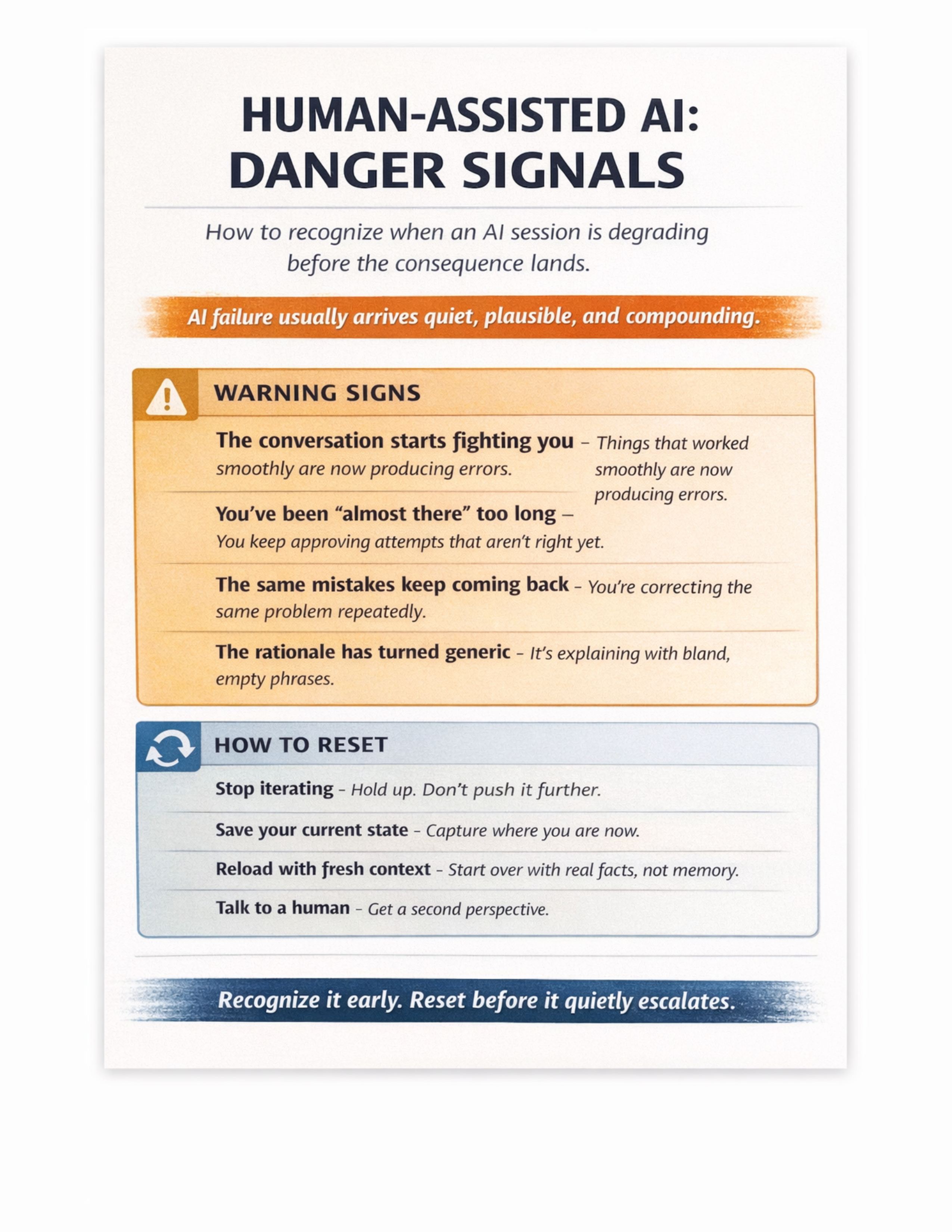
Danger Signals — recognizing a session going bad.
Long before a failure is obvious, there are signals. The conversation starts
fighting you. The same mistake keeps coming back. The rationale has gone generic.
You have been "almost there" too long. This quick card is built to sit next to
the monitor — something to glance at when the work starts to feel off but you
cannot yet say why.
Danger Signals — Quick Card · from Human-Assisted AI
The expanded version of the card — five warning signs, five trouble indicators,
and six reset actions — is part of the same toolkit and appears in the book's
session-discipline chapter.
The catalog · The book's most-reused asset
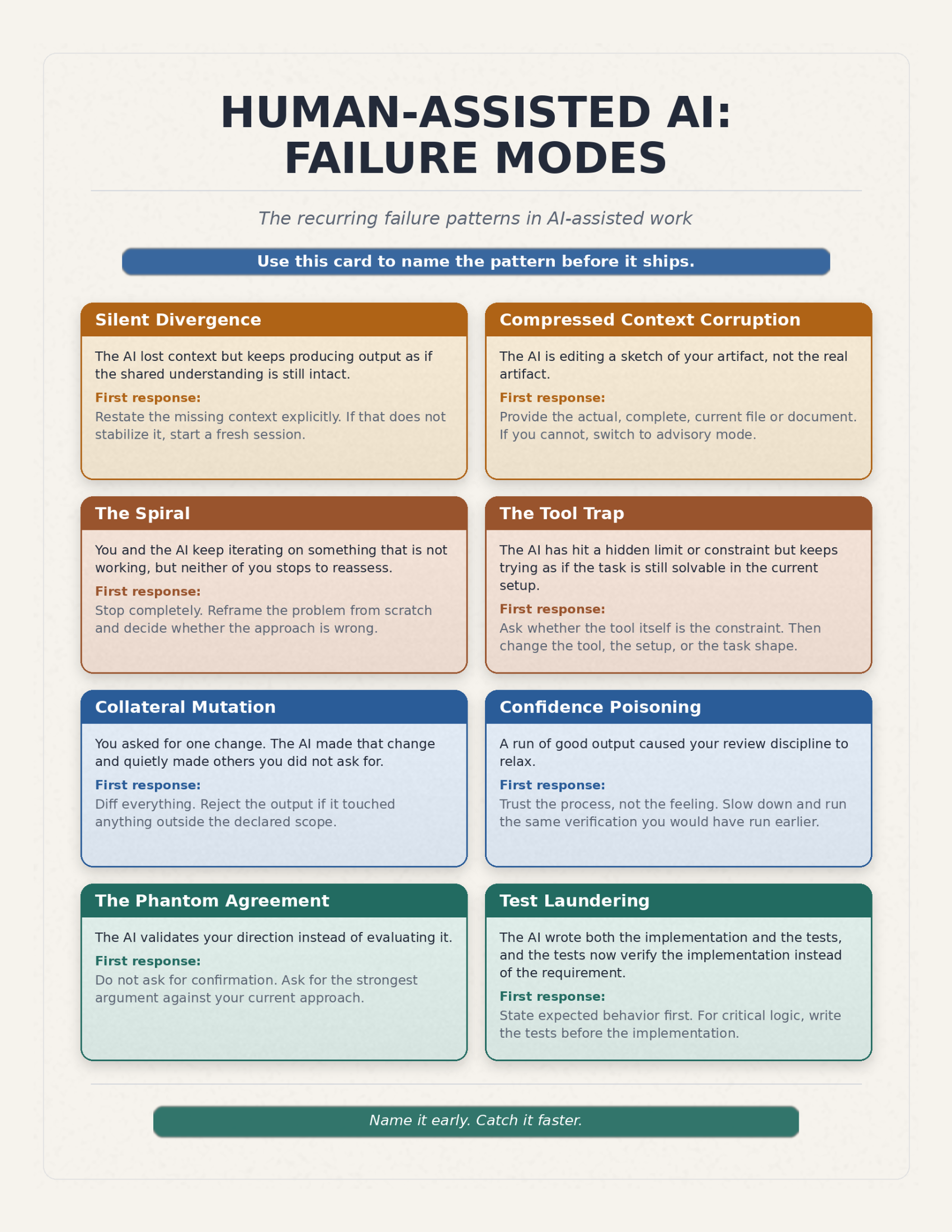
The Failure Mode Catalog.
Eight failure patterns. Each has a name, a short description of what the pattern
looks like in practice, and a first response that tends to work. The goal is not
to memorize the catalog. The goal is for the patterns to become
recognizable — so that in the middle of a review, someone on the team can say
"wait, that's Collateral Mutation" and the conversation can move to the fix
instead of rediscovering the problem.
The Failure Mode Catalog · from Human-Assisted AI
The eight patterns
Silent Divergence. The AI lost context but keeps producing output as if it still had it.
Compressed Context Corruption. The AI is editing a sketch of your artifact, not the real artifact.
The Spiral. You and the AI keep iterating on something that is not working, but neither of you stops to reassess.
The Tool Trap. The AI has hit a hidden limit but keeps trying as if the task is still solvable in the current setup.
Collateral Mutation. You asked for one change. The AI made that change and quietly made others you did not ask for.
Confidence Poisoning. A run of good output has caused your review discipline to relax.
The Phantom Agreement. The AI is validating your direction instead of evaluating it.
Test Laundering. The AI wrote both the implementation and the tests, and the tests now verify the implementation instead of the requirement.
What changes if you take this seriously
Recognition, then method, then scope.
If the failure modes are real, then three things follow. First, every team doing
AI-assisted work needs a shared vocabulary for the patterns. Second, that
vocabulary is only useful if there is a corresponding way of working — a
discipline that catches the patterns before they ship. Third, that discipline has
limits; it works in some kinds of AI work and not in others, and the boundary
needs to be named.
Each of those is the job of the next work in the body: The Confluent
Method is the practice. The Halocline is the boundary. Both depend
on the recognition layer this book provides.
Russo, P. (2026). Human-Assisted AI: What AI Is, How It Fails, and Why Your Engineering Discipline Is Your Best Defense. Riverbend Consulting Group. DOI: 10.5281/zenodo.19597521