What Is the Meridian Model?
Why AI-assisted software needs more than one kind of discipline.
Start here if the whole body of work is new.
Read the articleThe Meridian Model is a body of work comprising Human-Assisted AI, The Confluent Method, The Halocline, and The Discipline of Dependable Software. Together they name the failure patterns of AI-assisted work, define the method that responds to them, mark the boundary where that method stops, and anchor the whole system in the engineering philosophy underneath.
The articles explain the core ideas in plain language and point to the deeper publications behind them.
Why AI-assisted software needs more than one kind of discipline.
Start here if the whole body of work is new.
Read the articleWhy AI prototypes move fast, then stall on the way to production.
Read this when the demo worked and production still feels far away.
Read the articleWhy the human is still the differentiator in AI-assisted software work.
Read this when the output looks finished before it has been verified.
Read the articleA structured process for AI-assisted development.
Read this when the question becomes what to do with AI on real work.
Read the articleThe invisible boundary between creative AI work and operational AI work.
Read this when one AI label is hiding two different kinds of work.
Read the articleWhy software has to survive more than the first working version.
Read this when you want the engineering foundation underneath the model.
Read the articleThe publications below are the long-form source material behind these articles.
The articles are the discovery layer. These publications are the authority layer: the longer works, citation details, PDF previews, and complete source material behind the Meridian Model.
What AI Is, How It Fails, and Why Your Engineering Discipline Is Your Best Defense.
Read this if the work keeps going wrong in ways that feel familiar but still do not have names.
Read the publication pageThe Structured Process for AI-Assisted Development.
Read this when the question becomes: what do I actually do on Tuesday morning?
Read the publication pageThe Invisible Boundary Between Two Kinds of AI Work.
Read this when the question becomes: what about agentic AI?
Read the publication pageA Practical Philosophy for Long-Lived Systems. Using Clean Architecture as a foundation, not a rulebook.
Read this when you want the engineering foundation that lets the rest of the model hold up.
Read the publication pageThe Halocline is a branch from the method boundary — important, but not the gateway.
You can read the works in dependency order if you want the philosophy first. Most people arrive because one specific problem is already happening to them. Pick the one that sounds like yours.
I keep getting plausible but wrong output, and I can't always explain why.
I need a working method for creative AI-assisted development.
I'm trying to classify where agentic AI fits — and where it doesn't.
I want the engineering philosophy that makes all of this possible.
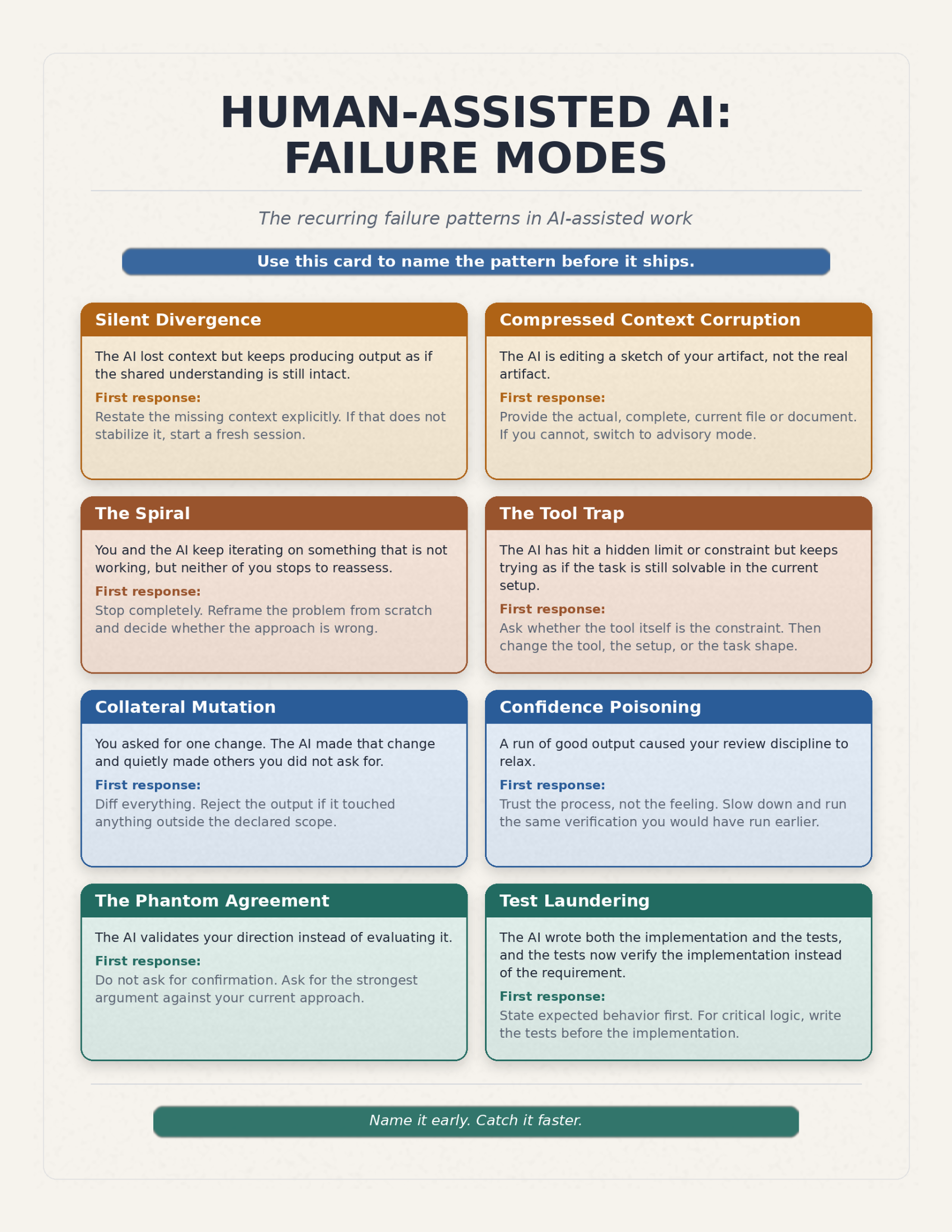
Silent Divergence. Compressed Context Corruption. The Spiral. The Tool Trap. Collateral Mutation. Confidence Poisoning. The Phantom Agreement. Test Laundering.
Once the patterns have names, teams stop treating them as isolated surprises. That is why Human-Assisted AI works as the gateway into the rest of the model — recognition is what pulls a practitioner into the method.
See the catalog in contextMost readers enter through recognition. Readers who want the philosophy first can work from the foundation upward. Both paths lead to the same place.
The Discipline of Dependable Software. The engineering philosophy beneath every other work — understandable, traceable, controllable systems.
Human-Assisted AI. The failure surfaces, the human role, and the reason discipline matters before any method is applied.
The Confluent Method. The actionable method for Creative AI Domain work. Small steps, verified output, human-confirmed completion.
The Halocline. The consequence of discovering that the method stops at the agentic / OAID boundary — and what to do with that.
All four works were first published in April 2026 and archived on Zenodo with persistent DOI identifiers for durable citation.
The open GitHub repository holds canonical PDFs, companion cards, proposal materials, and change history.
Written by Phil Russo. Published through Riverbend Consulting Group. Licensed CC BY 4.0 for reuse with attribution.
The works are free, citable, and open. Start with recognition, work outward toward method and scope. Or start at the foundation and work up. Both paths lead to the same place.